ERC-20 standard is insecure
Other exchanges keep supporting ERC-20 leading to proliferation of insecure standards and losses of funds. DEX223 is first to support ERC-223 which solves these problems

ERC-223




The first DEX built for both ERC-20 and ERC-223, and safer by design.
DEX223 is the first DEX to support both ERC-20 and ERC-223 standards. ERC-20 was the dominant standard for EVM chains since 2015 and its adoption led to exponentially increasing financial losses to the users of the ecosystem. We are here to stop the financial damage caused by obsolete early-days standards, user mistakes and approval scams.
Both standards
Trade ERC-20 and ERC-223 tokens side by side.
No approvals
ERC-223 swaps need no token approvals.
Lower gas
ERC-223 swaps can be 15% cheaper.
You pay
 USDT
USDT

 Approve

 Approve
You receive
 DAI
DAISecure, multichain, open to every token, and fully transparent.
DEX223 combines security, versatility, and transparency. With the ERC-223 standard, it prevents token transfer errors, supports seamless operation across multiple EVM-compatible blockchains, enables inclusive token listings, and ensures trust through publicly accessible financial reporting.
ERC-223 prevents the transfer errors that cost ERC-20 users millions.
Every year, millions of dollars are lost due to transaction errors involving ERC-20 tokens. By adopting the ERC-223 standard, DEX223 takes the first crucial step toward eliminating these costly mistakes. We are confident that this enhanced standard, which prevents fund losses, will become the industry norm in the long run.
Built for every EVM chain: Ethereum, Arbitrum, Optimism, BASE and more.
DEX223 is designed to operate seamlessly across all EVM-compatible blockchains, including Ethereum, EOS EVM, Arbitrum, Optimism, BASE, and many others. This broad compatibility ensures that DEX223 will be the most versatile exchange in the market, supporting the largest number of networks in the industry.
Any token can be listed, meme coins included.
Inclusivity is at the heart of DEX223. The protocol allows for any token to be listed, embracing the diverse and growing market of meme coins. Recognizing that listing these tokens can be challenging, we provide out-of-the-box solutions to make the process smooth and accessible for all projects.
How ICO funds are used is published openly on GitHub.
Transparency is a cornerstone of our operations. DEX223 adheres to a strict policy of financial openness, ensuring that the usage of ICO funds is publicly documented and accessible to everyone on Github. This commitment allows our community to trust and verify how funds are being managed and utilized.
An exchange that is unstoppable, secure and run by its users.
DEX223 is founded on the belief that a truly decentralized exchange must be unstoppable, secure, and governed by the people who use it. Our core principles revolve around user empowerment, transparent governance, and robust technical safeguards. By combining strict security measures with open, permissionless functionality, we aim to set a new standard in decentralized finance. Test DEX223 here
Secure by default
Strict safeguards at every layer.
Permissionless
Open to every token and every builder.
Community governed
Decisions belong to the people who use it.
New ideas for safer trading, easier listings and on-platform lending.
DEX223 introduces a number of revolutionary concepts that no other exchange implements in the same way currently. These features will drastically improve the security, make token listings as easy and transparent as possible and allow on-platform lending of assets.
Built and audited to remove single points of failure.
The safety of user funds is paramount. Every component, from smart contracts to the interface, must be designed and audited to eliminate single points of failure. Our encapsulated margin trading system and auto-listing mechanisms are built with a proactive approach to security, reducing exposure to malicious activities and user errors alike.
Listing fees and lending interest are shared with D223 holders.
The platform’s incentive models, such as the revenue-sharing program from listing fees and lending order interest, are aimed at sustainable growth. By sharing rewards with DEX223 token holders, we cultivate a symbiotic relationship between protocol success and investor engagement.
Smart contracts, not a company, run every step.
We envision an application that can operate indefinitely, free from external intervention or centralized oversight. Through smart-contract-driven listings, protocol-level governance, and distributed development, DEX223 aims to ensure that each step of trading, lending, and token listing is trustless and transparent.
Clear guides so everyone can trade safely.
DEX223 is committed to fostering a secure environment through clear documentation, step-by-step tutorials, and accessible user interfaces. Educating users about safe trading practices and platform risks empowers them to navigate the DeFi space with confidence.
Anyone can build, list and trade. No gatekeepers.
DEX223 embraces a model where anyone can build upon or integrate with our protocol. Tokens can be freely listed, and new financial instruments, like encapsulated margin trading, are made available to all participants without gatekeepers. This openness fosters ongoing experimentation and creativity in the ecosystem.
D223 holders vote on fees, features and proposals.
Holders of DEX223’s token are at the forefront of decision-making. Listing fees, new protocol features, and strategic proposals are subject to on-chain voting, ensuring direct democratic control over the platform’s development. This community-first design encourages transparent evolution of our protocol.
A permanent protocol, improved by its community.
By focusing on a seamless user experience, open integration paths, and a robust security framework, DEX223 strives to be the go-to platform for next-generation decentralized trading. Once deployed, the protocol becomes a permanent fixture in the DeFi landscape, governed and improved by its community.
 Curve hack
 DAO hack
 ERC-20 user errors
 Compound hack
 Wormhole hack
ERC-20 has no error handling, so one user mistake can lose tokens for good.
$201,690,000
See today's total in the ERC-20 Live Losses Calculator
Built around a 2015 bug
Designed around an old EVM bug, it cannot handle errors.
ERC-223 prevents mistakes
Built with security in mind to stop user errors.
ERC-20 standard violates common secure software design principles which resulted in a loss of $201M worth of tokens.
ERC-20 was designed in 2015. At that time there was a bug in EthereumVM. In order to make tokens not affected by this bug ERC-20 was designed in a clunky way which does not allow for error handling. As the result of impossibility of handling user mistakes $201M worth of ERC-20 tokens were lost.
ERC-223 is designed with security in mind. ERC-223 would allow to prevent user mistakes and we believe than in the long term a standard that prevents user mistakes and losses of funds will thrive.
Better security, open token listings and on-platform lending, done like no other exchange.
DEX223 introduces a number of revolutionary concepts that no other exchange implements in the same way currently. These features will drastically improve the security, make token listings as easy and transparent as possible and allow on-platform lending of assets.
Lend any token on your terms. Borrowers trade it but can't withdraw it. Live on testnet now, coming to Ethereum mainnet.
Any token
Place any token in your lending order.
Rate and deadline
Set the monthly interest rate and loan duration.
Permitted markets
Choose which markets the borrower can trade on.
Collateral and settings
Require minimum collateral and set optional parameters.
Collateral first
Borrowers deposit collateral to accept your order.
Trade, never withdraw
Funds trade on permitted markets but stay on DEX223.
Expected balance
You set the balance the borrower must hold over time.
Anyone can liquidate
Below that balance, anyone can close the positions for a reward.
No price oracles
Balances use real market sell value, not external oracles.
DEX223 introduces an innovative lending mechanism that enables users to create “lending orders” with full control over terms and conditions. Here’s how it works:
Encapsulated Margin Trading on DEX223 combines flexibility with robust safeguards, allowing users to lend and borrow on their own terms while keeping everyone’s funds protected.
Deep Dive: DEX223 Margin Trading Showcase video
ERC-223 fixes a core ERC-20 flaw and removes the approval step.
$201M
lost to ERC-20 design flaws by Aug 2023
15%
max GAS savings on some transactions
No approval step
You keep full control of your tokens while trading.
Powers margin trading
ERC-223 enables Encapsulated Margin Trading on DEX223.
ERC-20 fully supported
Wrap any ERC-20 via EIP-7417 and share one liquidity pool.
Integrating ERC-223 directly addresses a key shortcoming of the ERC-20 design, which has led to the loss of approximately $201,690,000 worth of tokens on Ethereum mainnet as of 29 August 2023. By adopting ERC-223, our platform ensures users have full control over their tokens during the exchange process, eliminating the need for traditional approval steps. This not only enhances security but can also reduce GAS costs by up to 15% in certain transactions.
Additionally, ERC-223 paves the way for implementing our “Encapsulated Margin Trading” feature, further expanding the scope of decentralized finance on the platform.
For users who still prefer ERC-20, the exchange will maintain full support alongside ERC-223, allowing a seamless fallback whenever necessary. As EIP-7417 moves toward standardization, it will enable ERC-20 and ERC-223 tokens to be used interchangeably. Through a simple wrapping process, any existing ERC-20 token can be upgraded to an ERC-223 equivalent, bolstering fund security. These wrapped tokens and their original ERC-20 counterparts will share unified liquidity pools, delivering both convenience and confidence to all participants.
Anyone can list a token. No permission from the exchange team needed.
Import any list
Bring any token list from tokenlists.org.
Permissionless listing
Add new tokens via the auto-listing contract.
Fees for stakers
Protocol fees can be shared with users who stake in the Revenue contract.
Fee voting next
On-chain voting for listing fees is coming soon. Until then, prices are set by the listing owner.
DEX223 empowers users to freely import any existing token list from tokenlists.org or integrate new tokens directly through our auto-listing contract. This open, permissionless approach allows anyone to list a token without seeking approval from the exchange team or intermediaries. Listing fees paid to auto-listing contracts are collected by the listing owner today. Protocol fee sharing for stakers is rolling out through the Revenue contract. On-chain community voting for listing fees is planned next.
Fees from every trade are shared with D223 holders.
Revenue to holders
Trading fees are distributed to D223 holders.
Unsold tokens excluded
Unsold tokens are removed from the total supply.
Monthly reports
Every use of raised funds is published.
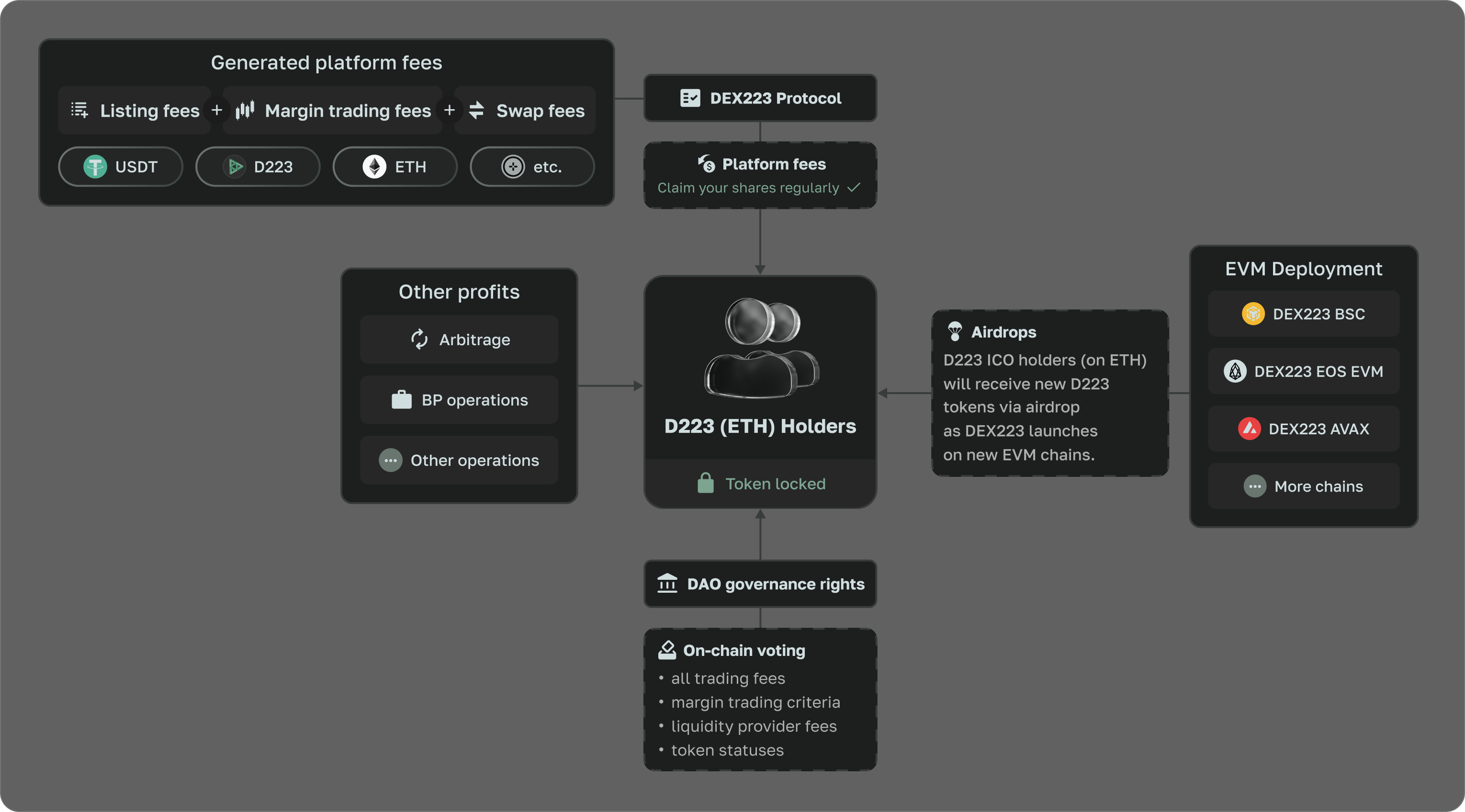
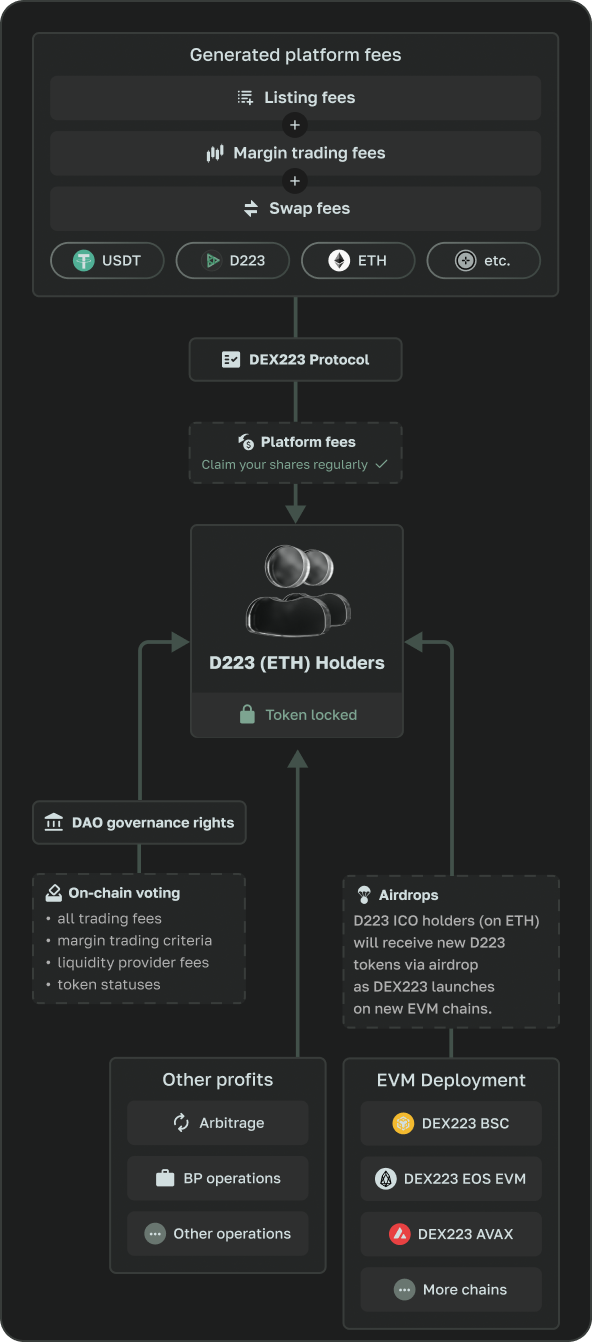
DEX223’s tokenomics draws inspiration from Ethereum’s highly successful launch model, emphasizing both security and sustainability. The original D223 tokens were issued in November 2023 on the Ethereum mainnet. Protocol fees collected into the Revenue contract can be claimed by users who stake the staking token there.
Any tokens that remain unsold will be removed from the total supply. For instance, if 32% of platform tokens are sold, the existing tokens will claim that revenue, effectively treating the remaining 68% as non-existent. Decision will be made by DEX223 DAO on redistribution of unsold tokens from pre-ICO or public rounds.
In the spirit of financial transparency, the development team commits to publishing monthly report detailing the distribution and use of any funds collected through ICO events or private sales, ensuring that every aspect of DEX223’s growth and progress remains visible to the community.
D223 starts on Ethereum, then follows DEX223 to every new chain.
Lock on Ethereum
Locked D223 is matched on each new chain.
8 confirmed chains
Ethereum, Avalanche, BSC, EOS EVM, CELO, Base, Optimism, Arbitrum.
Wider reach
Part of the team allocation goes to media partners.
D223 tokens will initially be offered on the Ethereum Mainnet, while the DEX223 exchange is scheduled to launch on multiple chains. Holders who keep their D223 tokens on Ethereum, and lock them in the smart contract, will receive an equivalent number of tokens on each new chain at the time of that chain’s DEX223 deployment.
To extend our reach, a portion of the core team’s D223 tokens will be allocated to influencers and media partners, amplifying awareness of our platform within their respective communities.
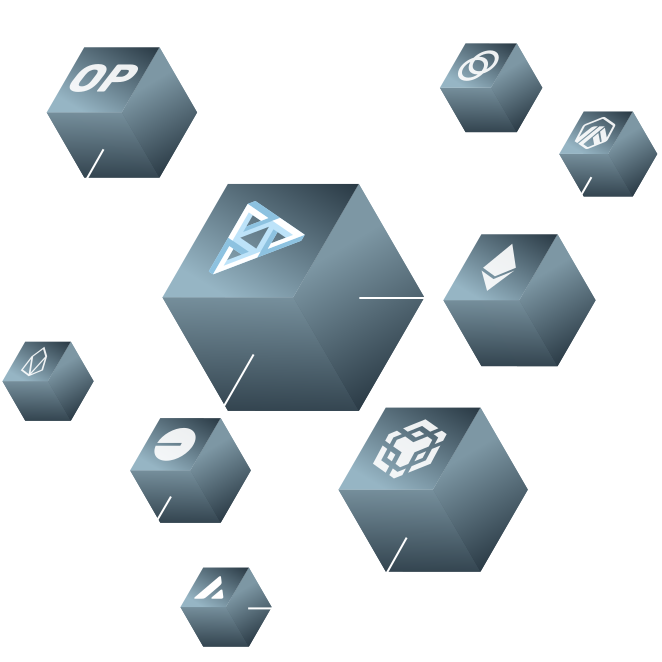
Confirmed chains for DEX223 deployment include Ethereum, Avalanche, BSC, EOS EVM, CELO, Base, Optimism, and Arbitrum. While these chains are confirmed, the team will prioritize and possibly change deployment strategy as it sees fit.
Everything you need to know about D223, at a glance.
An illustration of the fee model: on 29 August 2023, Uniswap V3 recorded $883 million in daily trading volume. At 5% of that volume and a 0.2% taker fee, DEX223 would collect about $2.65 million in fees per month, which the protocol shares with D223 stakers. This is an illustration, not a forecast or a promise of returns.
For more information about the D223 upgrade and how to transfer tokens directly to the contract, refer to the Token D223 upgrade guide.

Since 2017, one question: which standard keeps tokens safe?
ERC-223 knows the recipient
It picks the right deposit method automatically.
ERC-20 leaves it to you
Pick the wrong method and the tokens are lost.
Since 2017, a heated debate has raged over which standard, ERC-20 or ERC-223, offers a safer, more seamless experience. The core issue revolves around how tokens and Ether are deposited into externally owned addresses (controlled by individuals) versus smart contracts.
New to the standard? Read what ERC-223 is and how it compares with ERC-20.
To learn more about this ongoing rivalry and its impact on the broader ecosystem, visit the ERC-223 front page to uncover the full history since 2017.

We will announce our multi-chain timeline after the margin module audit. Visit our Github for the latest details and updates.
Q1 2024 (February-March)
Q2 2024 (April-June)
Q3 2024 (July-September)
Q4 2024 (October-December)
Q1-Q3 2025 (January-September)
2026 (in progress)
Future Milestones








We’re here to help you make the most of DEX223.
Releases, security updates and gas savings, straight to your inbox.